

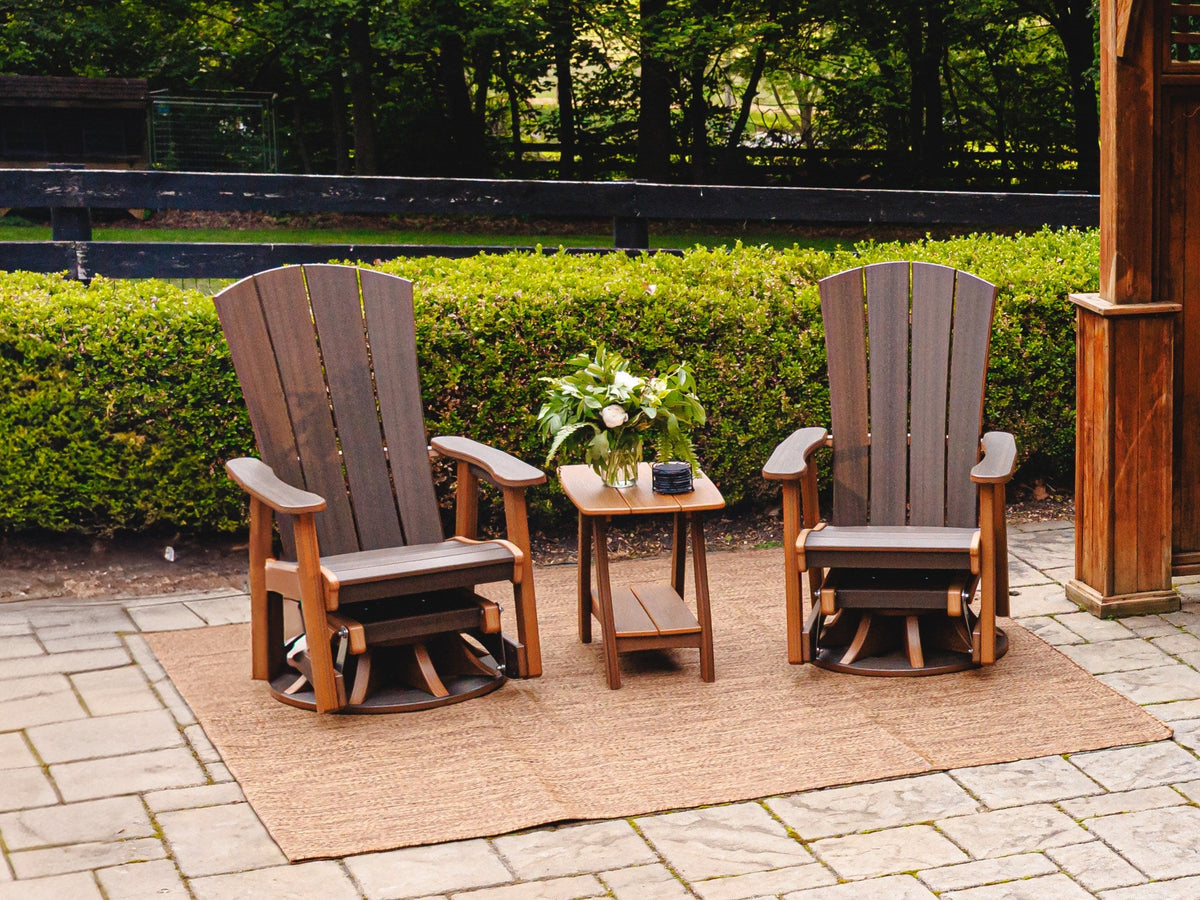
Choose an outdoor swivel chair when you want the seat to turn without adding a forward-and-back glide. Choose a swivel glider when the chair is for lounging and you want both rotation and a gentle gliding motion.
The difference changes more than the feel. A plain swivel chair can work at a dining, counter, or bar-height table. A swivel glider needs a larger operating zone because it turns and glides. Beaver Dam's current Serenity swivel chair rotates 360 degrees and comes in three height categories, while the Serenity swivel glider rotates 360 degrees and adds the glider format.[2][3]
Swivel chair vs. swivel glider at a glance
| Decision | Outdoor swivel chair | Outdoor swivel glider |
|---|---|---|
| Main motion | Rotates around its base | Rotates and glides forward and back |
| Typical use | Dining table, counter table, bar table, flexible upright seating | Conversation area, porch, lounge zone |
| Space to test | Arm and back sweep through a full turn | Full turn plus the forward-and-back glide path |
| Table pairing | Often designed in a specific seat height | Usually treated as lounge seating rather than a dining chair |
| Movement while seated | Changes direction without dragging the chair | Changes direction and adds a relaxing glide |
| Best first measurement | Table height, arm clearance, and turning sweep | Complete resting footprint, turning sweep, and glide travel |
| Nearby furniture | Table edge and neighboring chairs | Side tables, walls, railings, planters, and other seats |
A product name is not enough. Read the motion description and height options for the exact chair. Retailers sometimes group several moving-chair styles together, even though their operating space and table fit are different.
A plain swivel chair rotates without gliding
A swivel chair turns around a central base. It does not move forward and back unless the listing says it also glides or rocks.
This format is useful when the seat needs to face more than one direction but remain in one general spot. At an outdoor table, a person can rotate toward the seat opening before standing instead of scraping or dragging the chair across the patio.
Current Beaver Dam examples include the Serenity swivel chair, Seabreak swivel chair, and Farmhouse swivel chair. The Serenity and Farmhouse listings include dining, counter, and bar-height choices, while the Seabreak listing describes a 360-degree swivel on a stationary base.[1][2][5]
The table still controls the fit. A counter-height swivel chair should not be treated as a dining-height chair because both happen to rotate. Match the chair to the table before comparing color or style. The dining, counter, and bar-height guide explains that vertical pairing in more detail.
A swivel glider combines two motion paths
A swivel glider turns and moves forward and back. The base stays in place, but the seat moves relative to it.
That combination works well in a conversation area where someone may turn toward another person, the yard, or a view without moving the complete chair. It also means the resting footprint does not show every place the chair can reach.
The Serenity swivel glider and Empress swivel glider are current Beaver Dam examples. Both are sold as poly gliders, not as dining chairs.[3][4] The broader poly glider collection includes standard single gliders, loveseat gliders, swivel gliders, and rocking chairs.[6]
If you are also weighing a glider against a runner-based rocker, use the outdoor glider vs. rocking chair guide. That is a separate choice from deciding whether a glider should swivel.
Choose by activity before you choose by motion
The same 360-degree turn can serve two different jobs.
At a table
A swivel chair can make an upright dining or bar seat easier to enter and leave. It can also let someone turn away from the table for conversation without moving the chair's base.
Check three things:
- The seat height matches the table height.
- The arms clear the underside and edge of the table throughout the turn.
- The chair can rotate without hitting the next chair, table leg, railing, or wall.
Do the check with every chair in its likely position. One swivel chair may work at the end of a rectangular table while two side-by-side chairs interfere with each other.
In a lounge or conversation area
A swivel glider makes more sense when the seat is used away from a dining surface and the glide is part of the reason for buying it. The extra motion can help one chair serve several sightlines, but it also brings more objects into play.
A side table that is comfortable beside a stationary chair may sit inside the swivel or glide path. The outdoor side-table size guide can help with height and reach, but the table must also stay outside the chair's complete movement zone.
Measure the complete operating zone
Do not measure only the base. Mark every place the arms, back, seat, and user's feet may travel.
For a plain swivel chair, the operating zone includes:
- the base footprint;
- the widest sweep of the arms and back during a full turn;
- the user's knees and feet as the seat rotates;
- room to approach, sit, and stand; and
- any table or neighboring chair that enters that sweep.
For a swivel glider, add:
- the farthest forward position;
- the farthest rearward position;
- the turned-and-gliding positions, not only a straight glide; and
- extra clearance for a side table, ottoman, or another moving seat.
The turned-and-gliding check is the one most likely to be missed. A glider may clear a railing when it faces forward and still reach it after the user turns partway and glides back.
Run a six-step tape-and-turn test
Use painter's tape, a tape measure, and a dining chair or box to represent the seat.
- Mark the resting footprint. Use the complete frame dimensions, not the seat dimensions.
- Add the turning sweep. Mark the farthest point reached by the arms and back during a full rotation.
- Add the glide path. For a swivel glider, mark the forward and rearward travel as a separate layer.
- Place nearby objects. Mark the table, side table, railing, wall, planter, and neighboring chairs.
- Sit and turn. Check knees, feet, table clearance, entry, and exit with the regular user in the test position.
- Test the awkward angle. Turn the imagined seat diagonally, then check the glide path again.
Repeat the test with all chairs in the layout. A single chair may have plenty of room while a pair collides in the middle.
Surface and placement still matter
Both formats need a stable placement that supports the entire base. A chair that wobbles at rest will not improve when it starts moving.
Check for:
- paver joints or deck-board gaps under the base;
- a slope that makes the seat feel uneven;
- a rug edge that catches the base or feet;
- soft ground that lets one side settle; and
- water, sand, leaves, or grit around moving parts.
Test the exact chair on the exact surface whenever possible. Avoid assuming that a product will behave the same way on a showroom floor, a textured patio, and a deck.
Plan for inspection and cleaning
A stationary chair mainly asks you to inspect the frame and fasteners. A swivel chair adds a rotating base. A swivel glider adds both the rotating base and the gliding mechanism.
Before buying, find out how the manufacturer wants those moving parts cleaned and inspected. Do not apply a lubricant or cleaner simply because it worked on a different chair. Materials, bearings, bushings, coatings, and hardware can vary.
At the start of the season, turn and move the empty chair through its full path. Stop using it if the movement becomes rough, uneven, loose, or noisy until the cause is identified.
Which one should you choose?
Choose a plain outdoor swivel chair when:
- the chair belongs at a dining, counter, or bar-height table;
- rotation is useful but a glide is not;
- the patio has enough turning clearance but limited front-to-back room;
- you want an upright seat that stays in one general position; or
- the household frequently turns to enter or leave the table.
Choose a swivel glider when:
- the chair belongs in a lounge or conversation zone;
- both turning and gliding are part of the desired experience;
- the complete two-motion zone clears walls, tables, and walkways;
- the seat needs to face several views or groups; or
- a standard glider feels too fixed in direction.
Neither format is automatically better. The right one matches the activity, table height, user, surface, and complete movement path.
Final checklist
Before ordering, confirm:
- whether the chair swivels only, swivels and glides, or swivels and rocks;
- the correct dining, counter, or bar-height configuration if it goes at a table;
- the complete frame dimensions;
- the full arm, back, knee, and foot sweep during rotation;
- the forward and rear glide travel, if applicable;
- clearance from tables, railings, walls, doors, and neighboring chairs;
- a stable surface under the full base;
- the manufacturer's inspection and care instructions; and
- whether the taped operating zone still leaves a usable walkway.
Frequently asked questions
Is a swivel chair the same as a swivel glider?
No. A plain swivel chair rotates around its base. A swivel glider rotates and also moves forward and back.
Can a swivel glider be used at an outdoor dining table?
It is usually a lounge format rather than a dining chair. Use a chair designed for the table's height and confirm arm, knee, and turning clearance. Do not pair a glider with a table only because the seat can swivel.
Does a swivel glider need more room than a swivel chair?
Usually, because it has two motion paths instead of one. The exact operating zone depends on the chair's frame and mechanism, so trace the turn and glide rather than relying on a universal clearance number.
Is a swivel glider the same as a swivel rocker?
Not necessarily. A glider moves forward and back through a linkage. A rocker moves through an arc. Product names are sometimes loose, so verify the mechanism in the listing.[7]
What is the easiest mistake to make?
Measuring the resting base and ignoring the arms, back, knees, feet, and turned glide path. Test the chair as a moving zone, not a static rectangle.
Sources
[1] Swivel Chair | Seabreak Collection
[2] Swivel Chair | Serenity Collection
[3] Swivel Glider | Serenity Collection
[4] Swivel Glider | Empress Collection
[6] Poly Glider Collection | Beaver Dam Shop
[7] Outdoor Glider vs. Rocking Chair: Which Fits Your Patio?


