

Choose an outdoor ottoman when your first priority is putting your feet up. Choose a coffee table when the seating area needs a stable shared surface for drinks, snacks, books, or serving. If both jobs matter, an ottoman plus a small side table is often easier to place than one large piece that does neither job especially well.
The decision gets clearer once you stop treating both pieces as interchangeable rectangles. An ottoman belongs in the sitter's leg space. A coffee table belongs in the shared reach zone. Their height, footprint, surface, and care needs are different.
Ottoman vs. coffee table at a glance
| Decision | Outdoor ottoman | Outdoor coffee table |
|---|---|---|
| Main job | Foot and leg support | Stable shared surface |
| Best placement | Directly in front of one seat or movable between seats | Centered where several seats can reach it |
| Surface | Rigid poly or cushioned, depending on the model | Firm tabletop |
| What to measure first | Seat height, leg reach, and footrest angle | Table height, top size, and seated reach |
| Traffic concern | Can drift into the standing path | Can become a fixed obstacle in the center of the group |
| Weather routine | Cushioned versions need fabric-specific care | Hard poly tops need routine cleaning |
| Extra use | Only if the exact product is rated for sitting or holding items | Only if the exact product is rated for feet or sitting |
Do not choose by appearance alone. A beautiful coffee table that is too far away will go unused. An ottoman that blocks the only walking route will be moved every time someone stands up.
Start with the job you need every day
Picture the seating area during an ordinary hour, not a party.
If you usually read, nap, or sit back with your legs raised, the ottoman solves the more important problem. If the space is used for coffee, snacks, games, or serving several people, the table earns its footprint.
Ask these questions:
- Do people regularly want foot support?
- How many seats need a place for a drink?
- Does one person use the area most often, or does a group gather there?
- Will the piece need to move before someone can stand?
- Is there already a side table within easy reach?
A single lounge chair with a nearby drink table has different needs from a loveseat and two chairs arranged around a shared center. Our outdoor loveseat-versus-two-chairs guide explains how to measure the complete seating zone before adding the center piece.[5]
A rigid ottoman and a cushioned ottoman are different purchases
"Ottoman" can describe more than one construction.
A rigid poly footrest is shaped to support the legs and can usually be cleaned with the same routine used for the matching poly chair. The current Majestic Contoured Ottoman, for example, is a 22-by-20-by-14.25-inch poly piece designed to pair with Majestic Adirondack chairs.[1]
A deep-seating ottoman usually adds a cushion. That changes the ownership routine. The frame and cushion should be evaluated separately, and the fabric label or exact product instructions should control cleaning, drying, and storage. Our deep-seating patio furniture guide covers the cushion questions worth checking before purchase.[4]
Neither construction should automatically be treated as a spare seat or tray table. Confirm the intended uses and any capacity limits for the exact product. A flat-looking cushion is not the same thing as a hard serving surface.
A coffee table needs usable top space and reachable height
A coffee table serves several seats at once, so its top size and placement matter as much as its style.
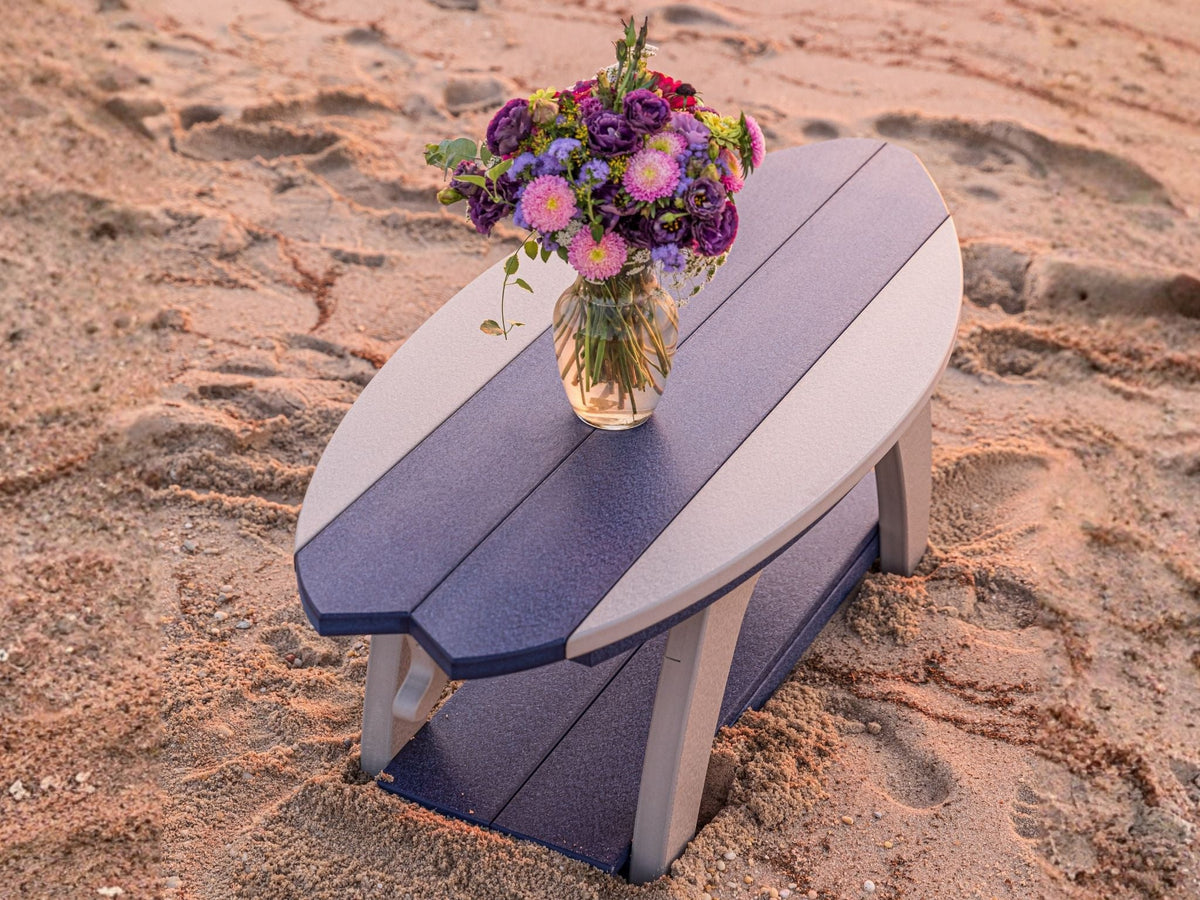
The current SurfAira Coffee Table measures 47 by 21 by 18 inches and includes a lower shelf.[2] Those are the dimensions of that product, not a universal outdoor coffee-table standard. Use them as a real example of the difference between a long shared surface and a compact footrest.
Before buying a table, list what must fit on top during normal use:
- a drink for each regular seat;
- a serving tray or snack bowl;
- books, phones, or a game;
- any decor that will stay on the table; and
- clear space around hot, wet, or breakable items.
Then test the height while seated. A table can be visually proportional and still feel awkward if everyone has to lean too far forward. The same seated-reach test used for side tables is useful here, although a coffee table must work for more than one seat.[3]
Measure the center zone, not just the furniture
The usable footprint includes the piece plus the body movement around it.
For an ottoman, mark:
Ottoman zone = ottoman footprint + leg approach + room to stand
For a coffee table, mark:
Coffee-table zone = table footprint + seated reach + walking clearance
These are planning formulas, not fixed clearance rules. The actual space depends on the chair depth, seat height, user, and traffic pattern.
Use overall furniture dimensions. Do not substitute cushion size, seat size, or a product photo. If a piece moves, reclines, glides, swivels, or rocks, measure the operating path as well as the resting footprint.
Watch the path from sitting to standing
An ottoman lives where the feet want to travel. That is also where the body moves when someone leans forward and stands.
Test the sequence:
- Sit in the normal position.
- Place your feet on the proposed ottoman.
- Bring your feet back to the floor.
- Lean forward and stand.
- Walk out without twisting around the furniture.
If the ottoman must be kicked aside each time, decide whether that small chore will become annoying. A lighter movable footrest may be fine for one user. It is less convenient when several people need the same path.
A coffee table creates a more permanent center obstacle. Make sure knees, shins, and feet have a natural route between the seats and the table. Check the narrowest exit from the grouping, not only the open side facing the yard.
Moving chairs need another layer of clearance
Gliders, rockers, swivel chairs, and reclining seats can collide with a center piece even when everything looks comfortable at rest.
Run the chair through its complete motion with a cardboard mockup in place. Check:
- the forward reach of feet and legs;
- the back-and-forth travel of a glider;
- the arc of a rocker;
- the arm and back sweep of a swivel chair; and
- the recline path of a chaise or adjustable seat.
Keep the table or ottoman outside that path. A few inches of overlap may not show up until someone turns or glides with a drink sitting nearby.
When an ottoman plus a side table works better
You do not have to force one center piece to handle both comfort and serving.
An ottoman can support the feet while a compact side table holds the drink. This arrangement often works well for one or two lounge seats because each piece can sit where its job makes sense.
The tradeoff is that two pieces create two footprints. Measure the complete arrangement and the path around it. Our outdoor side-table size guide explains how to match table height to the chair and keep moving parts clear.[3]
This combination is a strong option when:
- one regular user wants a footrest;
- a central coffee table would sit too far from the chair;
- the patio has an irregular shape;
- seats move independently; or
- you want the option to remove the ottoman when more floor space is needed.
Use this five-step cardboard test
A mockup answers more than a product photo.
1. Mark the seat positions
Place every chair, loveseat, or sofa where it will actually sit. Include the complete frame and any motion path.
2. Build the two options
Use boxes or firm cushions to approximate the proposed ottoman and coffee table. Match the published length, width, and height as closely as possible.
3. Test normal use
Sit with your feet up on the ottoman mockup. Then replace it with the table mockup and reach for an empty cup, book, and serving tray. Do not lean farther than you would during an ordinary evening.
4. Walk every route
Move between the house, chairs, yard, grill, steps, and doors. Test the area with other seats occupied. A center piece that works for one empty chair may fail once the whole group is seated.
5. Leave the mockup overnight
Walk past it again the next day. The second look catches obstacles that feel obvious only after the excitement of rearranging the patio wears off.
How to choose for your seating area
Choose an outdoor ottoman when:
- foot support is the main need;
- one or two seats use the area most often;
- a side table already handles drinks;
- the piece can move without becoming a nuisance; and
- its height and shape work with the exact chair.
Choose an outdoor coffee table when:
- several seats need one shared surface;
- serving, games, or snacks are common;
- the top is reachable without a deep forward lean;
- the center path remains open; and
- moving chairs clear the complete table footprint.
Choose both only when the patio has room for both complete zones. If you are pairing a footrest with an Adirondack chair, settle the chair's seat height and recline first. Our Adirondack chair fit guide covers that decision.[6]
Questions shoppers ask
Can an outdoor ottoman be used as a coffee table?
Only if the manufacturer says the exact ottoman can hold the intended items. A cushioned top is not a stable surface for open drinks. A rigid footrest may still have a curve or slats that make serving awkward.
Can I put my feet on an outdoor coffee table?
Do that only if the product instructions allow it. A coffee table is designed first as a tabletop, and using it as a footrest may stress the top or base in a way the manufacturer did not intend.
How close should a coffee table be to outdoor seating?
There is no single distance that fits every chair and user. Build a full-size mockup, sit normally, and check whether you can reach the table without crowding your knees or blocking the standing path.
What height should an outdoor ottoman be?
Match it to the seat and the user's preferred leg position. Test the exact chair and footrest together. The Majestic example is 14.25 inches high, but that number should not be copied to unrelated seating.[1]
Do I need a coffee table if I already have side tables?
Maybe not. Side tables can give each seat a closer drink surface while leaving the center open. A coffee table becomes more useful when the group needs shared serving space or a place for games and larger items.
Sources
[1] Contoured Ottoman | Majestic Collection
[2] Surfboard Coffee Table | SurfAira Collection
[3] Outdoor Side Table Size Guide
[4] Deep Seating Patio Furniture Guide


