

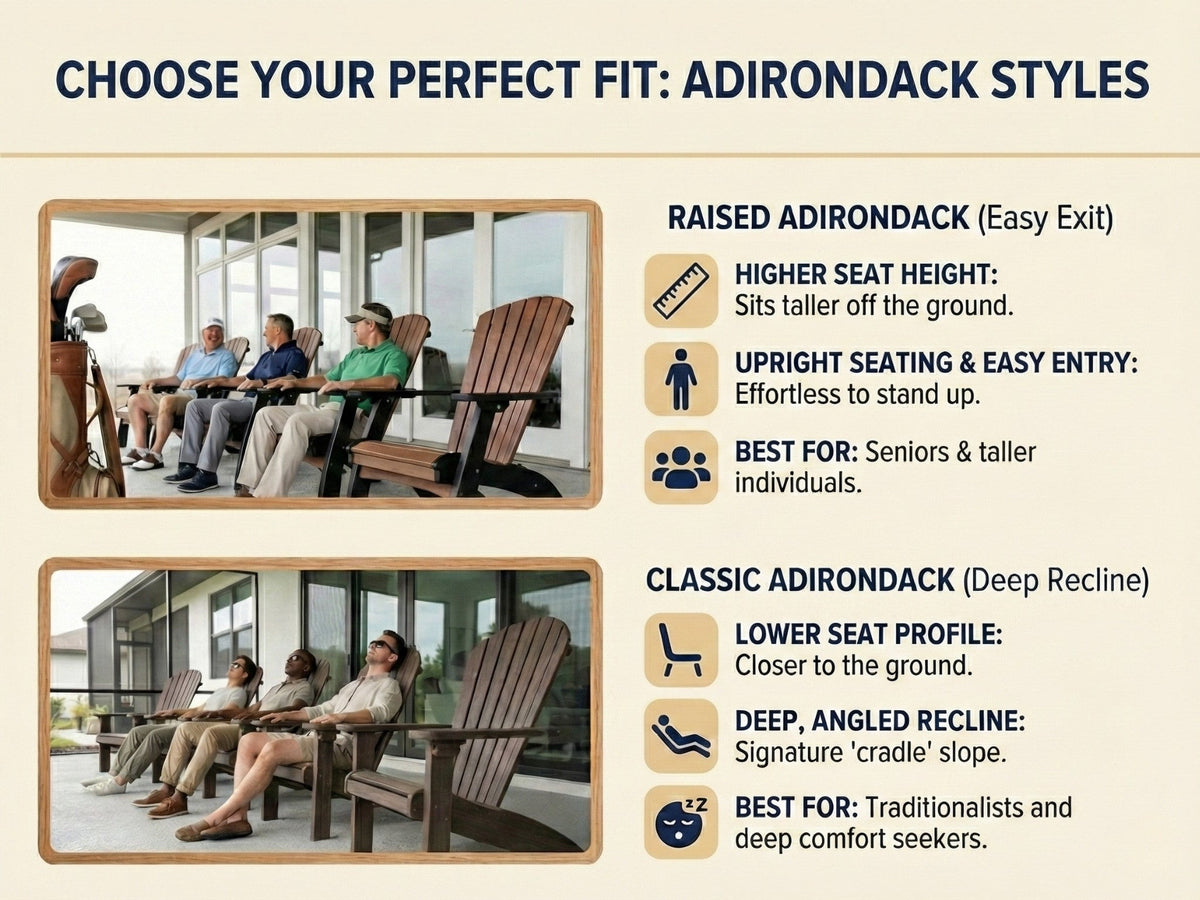
Choose an Adirondack chair by checking the seat height and slope first, then the usable seat size and full footprint. A low, deeply reclined chair suits laid-back lounging. A raised or more upright chair is the better starting point if you want less of a drop when sitting down and an easier rise. Color comes after fit.
That sounds simple, but Adirondack dimensions can be surprisingly easy to misread. The familiar wide arms and sloped seat hide meaningful differences between models. Some listings give seat-area measurements. Others call out the height at the back of the seat. Those numbers answer different questions, so comparing the biggest number in each listing can lead you astray.
The four measurements that decide Adirondack chair fit
1. Seat height and slope
A conventional Adirondack chair drops toward the back. That recline is part of the appeal, but it also places your hips lower than the chair's front edge. Check where a product measures seat height before comparing it with another chair.
The current Majestic product page makes the distinction clear. Its raised version is 13 inches from the ground to the back of the seat, while the classic version is 11 inches at that point.[6] The raised model also levels the seat somewhat and is sold as the "Easy Exit" choice. The classic model keeps the deeper recline.
Higher, more level seats and supportive arms can make sitting and standing easier for some people.[10][11] There is no single best seat height for every body, though. Compare the chair with one you already use comfortably instead of relying on a generic ideal.
2. Usable seat width and depth
Overall chair width includes the arms. It does not tell you how much room there is between them. Look for the listed seat dimensions, then compare those measurements with a familiar chair.
Seat depth deserves just as much attention. A deeper seat can feel roomy when reclining, but it may not suit someone whose knees do not reach the front edge comfortably. If a cushion will be used, remember that it can reduce usable depth and raise the sitting position.
3. The full footprint
Seat dimensions are not floor-space dimensions. Both Beaver Dam Siesta product pages list a 20 × 23 × 16.5-inch seat area and explicitly say that those numbers do not represent the chair's overall footprint.[7][8]
That warning matters on a small porch or beside a fire feature. Before ordering, confirm the chair's total width and front-to-back depth. Then account for the route people will use to reach the chair. A roomy seat is not helpful if an arm blocks a door or the front legs crowd the only walkway.
4. Folding, moving, and seasonal storage
A folding frame can make a chair easier to store, but "folding" does not automatically mean compact or lightweight. Check the folded dimensions and product weight if either one affects where you will keep it. If the chair will stay put, a stationary frame removes a step from setup.
The Majestic chair is currently offered with stationary and folding choices.[6] Decide between those only after choosing the classic or raised seating position. Storage convenience will not fix a seat that feels too low or too upright.
A five-minute fit test at home
You can narrow the choice before visiting a showroom or placing an order.
- Find a chair that is comfortable to enter, sit in, and leave.
- Measure from the floor to the seat at the point where your hips rest. On a sloped chair, record the front and back heights if you can.
- Measure the clear width between the arms and the usable seat depth.
- Use painter's tape to mark the proposed Adirondack chair's confirmed overall footprint on the patio or porch.
- Sit in the familiar chair inside that taped area. Check the nearby door swing, side-table position, foot room, and walking path.
If two people will use the chair often, take measurements from a chair each person likes. The right choice may be the one that avoids an uncomfortable extreme rather than the lowest or deepest chair available.
Current Beaver Dam Adirondack examples
The figures below are copied from the current product pages. Keep the labels attached to the numbers: these are listed seat measurements, not full chair footprints.
| Chair | Listed seat dimensions | Fit detail to notice |
|---|---|---|
| Majestic Raised (Easy Exit) | 19.5 × 22 × 16 in. | 13 in. from the ground to the back of the seat; more level sitting position.[6] |
| Majestic Classic (Deep Recline) | 19.5 × 23 × 15.25 in. | 11 in. from the ground to the back of the seat; deeper recline.[6] |
| OceanWavz Siesta | 20 × 23 × 16.5 in. | The listing says these are seat-area dimensions, not the overall footprint.[7] |
| Serenity Siesta | 20 × 23 × 16.5 in. | The listing gives the same seat-area warning.[8] |
These examples show why a single "seat height" filter cannot settle the choice. The Majestic listing separately identifies the back-of-seat height. The Siesta listings provide a seat-dimension set and warn against treating it as the footprint. When two product pages use different labels, ask for the same measurement on both before comparing.
You can review the full Beaver Dam Adirondack collection, then open the individual products for current options and specifications.
Classic, raised, or Siesta: which one fits the way you sit?
Choose a classic deep recline when
- you want the traditional low, leaned-back Adirondack position;
- getting into and out of a low seat is comfortable for the regular users;
- the chair is mainly for relaxed conversation, reading, or putting your feet up.
The Majestic Classic Adirondack is the direct Beaver Dam example. Its listed back-of-seat height is two inches lower than the raised version.[6]
Start with a raised chair when
- a low seat makes standing up inconvenient;
- you prefer a more upright view across the yard or patio;
- several guests will use the chair and an easier entry and exit matters more than a deep recline.
The raised Majestic keeps the familiar Adirondack shape while changing the sitting position. If mobility is a concern, treat the published measurements as a screening tool, not a substitute for trying a comparable seat safely.
Consider a Siesta chair when
- you like a contoured, reclined chair but want a different back style;
- the listed 20 × 23 × 16.5-inch seat area compares well with a chair you already use;
- you can confirm the full footprint for your space.
The OceanWavz Siesta has a wave-cut back. The Serenity Siesta offers a different back design with the same listed seat-area dimensions.[7][8]
Do not let material and motion distract from fit
Material affects care and long-term ownership, but it does not tell you whether a chair's geometry suits you. Read our HDPE outdoor furniture guide for the material questions, then return to seat height, recline, and dimensions for the fit decision.
The same goes for movement. If you want a chair that rocks or glides rather than a stationary lounge seat, compare that use case first. Our outdoor glider versus rocking chair guide explains the motion difference.
Adirondack chair fit checklist
Before buying, make sure you can answer these questions:
- Where was seat height measured: front edge, lowest point, or back of the seat?
- What are the clear seat width and usable depth?
- What are the full chair width and depth?
- Does the footprint leave the door and walking route clear?
- Is the chair's recline comfortable for the people who will use it most?
- Do you need a folding frame, and where will it go when folded?
- Will a cushion change the seat height or usable depth?
If a listing does not supply the measurement you need, pause and ask. A missing overall depth is a reason to get the number, not a reason to assume the seat depth is close enough.
Frequently asked questions
What Adirondack chair height is easiest to get out of?
A higher, more level seat is usually the better starting point for someone who finds low chairs difficult, especially when the chair has supportive arms.[10][11] Individual fit still matters. Compare the published back-of-seat height and slope with a chair the user already handles comfortably.
How much room does an Adirondack chair need?
Use the model's full width and front-to-back depth, not its seat dimensions. Add the real route people need to reach the chair and any clearance required by doors or nearby furniture. There is no reliable one-size allowance because chair footprints and patio layouts differ.
Is a wider Adirondack chair automatically more comfortable?
No. Extra width can help if the usable space between the arms is what you need, but depth, slope, arm position, and leg support also affect fit. Compare several measurements with a chair you already like.
Should I choose color before style?
Choose the seating position and dimensions first. Once you have the right model, use its current product page to see available colors. This avoids falling in love with a finish on a chair that is too low, too deep, or too large for the space.
Sources
[7] OceanWavz Siesta Adirondack Chair
[8] Serenity Siesta Adirondack Chair


