

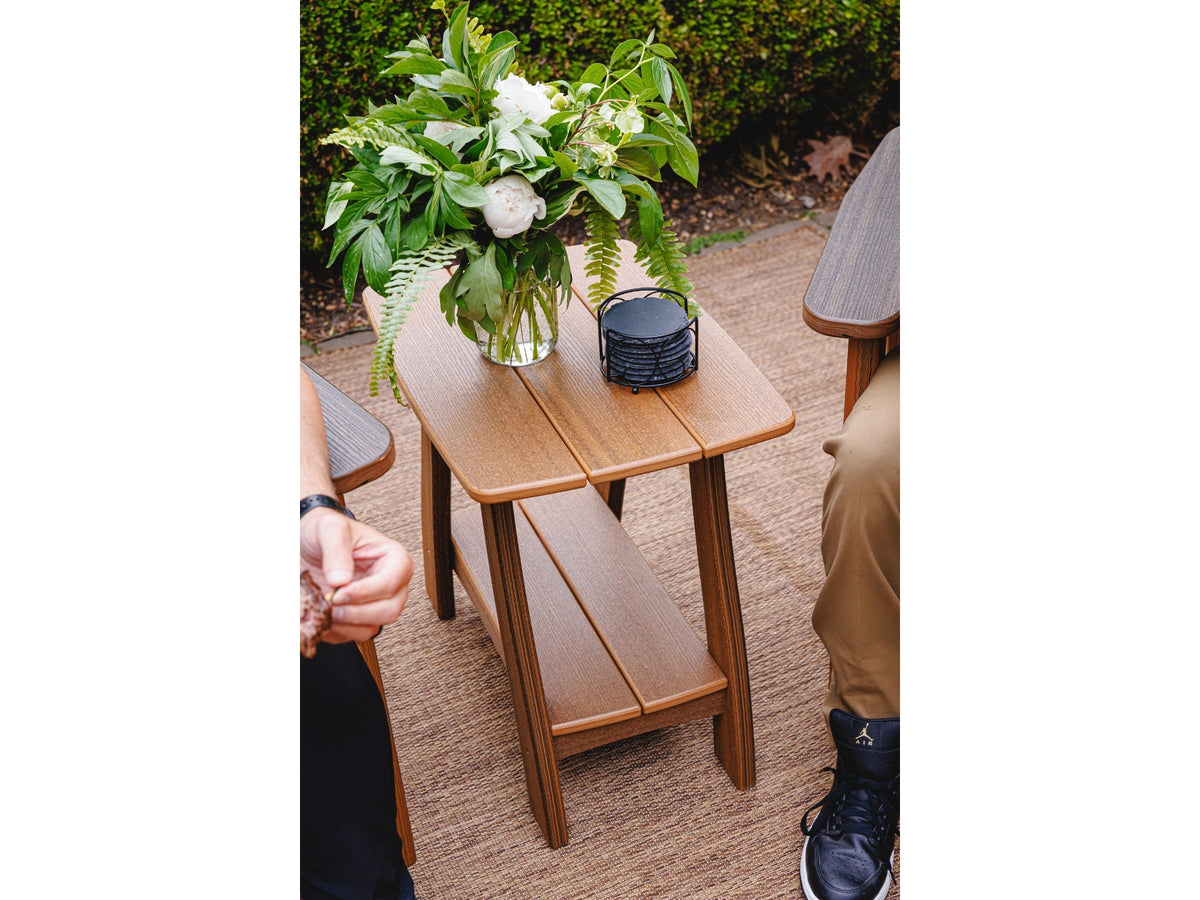
Start with the chair, not a generic table-size chart. Measure from the patio surface to the top of the chair arm, then test a tabletop near that height while you are actually seated. After the height feels comfortable, check that the top will hold what you use and that the complete table fits beside the chair without crowding feet, moving parts, or a walking path.
That method matters because outdoor side tables vary more than their names suggest. Beaver Dam's folding SurfAira table is 18 inches high.[4]
Other current Beaver Dam tables add 21-, 22-, 28-, and 34-inch options.[2][3][5] There is no single outdoor side-table height that suits a low chaise, an Adirondack chair, a deep-seating sofa, and a bar chair.
Match the tabletop to the way you sit
Chair-arm height is the most useful first measurement for a side table. A tabletop near the arm gives your hand a short, natural path to a drink, phone, or book. Current patio-table guidance uses the same starting point and recommends a seated reach test rather than choosing by appearance alone.[6]
Measure in this order:
- Put the chair in its normal position on the actual patio surface.
- If it has a cushion, sit long enough for the cushion to compress.
- Measure from the floor to the highest part of the arm where your hand passes over it.
- If the chair has no arm, sit as you normally do and note where your hand reaches comfortably to the side.
- Compare that number with the table's finished height.
You can record the comparison as a simple difference:
Height difference = table height − chair-arm height
A result near zero is a sensible first candidate, but it is not an automatic pass. Wide arms, a reclined back, a tray lip, or a tabletop set several inches away can change the reach. Mock up the height before ordering.
For an Adirondack chair, measure the arm instead of trying to infer table height from the low rear seat. The recline changes where your body rests. If you are still choosing the chair, our Adirondack chair fit guide explains how seat height, slope, and footprint differ among designs.
For cushioned lounge furniture, test the table after the cushion compresses under a person. The deep-seating patio furniture guide covers the other frame and cushion measurements that affect the setup.
Compare real Beaver Dam side-table sizes
The product name will not tell you the finished height. Even category labels such as lounge, dining, counter, and bar are not used identically on every page, so compare the measurements themselves.
| Beaver Dam table | Current dimensions | What the dimensions tell you |
|---|---|---|
| SurfAira folding surfboard end table | 28 × 16 × 18 inches | Low profile, narrow depth, long surface, folds for moving or storage.[4] |
| Majestic two-tier end table | 21 × 15.75 × 21 inches or 21 × 15.75 × 28 inches | Same compact top in two heights, with a lower shelf.[3] |
| Seabreak 24-inch square end table | 24 × 24 inches; 22, 28, or 34 inches high | A square top with three height choices.[2] |
| Serenity round end table | 24 × 24 inches; 22, 28, or 34 inches high | A round 24-inch footprint, three height choices, and a lower shelf.[5] |
These are current product-page dimensions, not universal standards. Use the exact listing for the table you plan to buy, especially when a model has more than one height.
Choose the top size by giving it a job
A side table for one cup and a phone needs less surface than a shared table for two chairs. Write down what the table must hold before comparing widths and shapes.
A practical test is to place those objects on a sheet of cardboard, leaving enough room to pick them up without catching another item. Trace the smallest rectangle or circle that works. That outline becomes your minimum useful top, subject to the actual product shape and slat spacing.
Consider these common setups:
- One chair: Test the drinkware, book, phone, or small plate you use most often.
- Two chairs sharing one table: Place two sets of items on the mock top, then sit in both chairs and check the reach from each side.
- A table with a lower shelf: Decide whether the shelf will hold items you want off the tabletop. Then confirm you can reach it without putting a hand near moving chair parts.
- A folding table: Check both its open dimensions and where it will go when folded. Folding solves storage, but it does not make the open footprint smaller.
Do not use a side table as a seat, step, or support unless the product instructions explicitly allow that use.
Check the base as carefully as the top
A top may clear the chair arm while the legs collide with a runner, wheel, ottoman, or wide chair base. Check the table at floor level as well as arm level.
Measure the clear floor zone beside the chair:
Available side-table zone = clear width × clear depth
The candidate table must fit inside that zone in its normal orientation. If the top overhangs the base, trace both shapes. Keep the overhang visible in your mockup so a knee or shin does not find it first.
Moving seats need another test. A glider, rocker, swivel chair, or chair paired with an ottoman uses more space in motion than it does while empty. Move the seat through its complete normal range with the table mockup in place. Our outdoor glider vs. rocking chair guide explains why the moving footprint matters.
Also walk the route past the chair. Carry a tray or laundry basket if that is how the patio is used. A table that fits on paper can still become the corner everyone clips on the way to the door.
Round, square, rectangular, or folding?
Shape changes how the same surface area fits into a patio.
A round top removes projecting corners and can work well where people approach from more than one direction. A square top uses a predictable block of floor space and can give two neighboring chairs equal access. A narrow rectangle places more surface along the chair arm without taking the same front-to-back depth as a large square. A folding design is useful when the table moves often or must be stored between uses.
Choose by tracing the actual dimensions on the floor. Do not assume that round always saves space or that a narrow table always feels smaller. Diameter, length, width, leg position, and top overhang all affect the result.
Run this five-minute fit test
You need a tape measure, painter's tape, a box or stack of books, and the chair that the table will serve.
- Measure the seated reach. Record the arm height or the comfortable hand position beside an armless seat.
- Build the candidate height. Stack a sturdy box or books to the listed table height. Do not balance breakable objects on the mockup.
- Trace the top and base. Mark the listed length and width, or diameter, on cardboard and on the floor with painter's tape.
- Use the setup. Sit back, place an empty cup, phone, and plate on the mock top, and repeat the reach several times.
- Move everything that moves. Stand up, pull the chair, operate the glider or rocker, extend the ottoman, and walk the nearby route.
If two people will share the table, both should run the test from their usual chairs. The better size is the one that works for the real users and still leaves the patio usable.
A short buying checklist
Before choosing from the Beaver Dam poly end-table collection, confirm:
- the exact finished height, rather than relying on words such as lounge or counter;
- the top dimensions and shape;
- the base footprint and any top overhang;
- the chair-arm height and seated reach;
- the items and number of people the top must serve;
- clearance for chair movement, ottomans, doors, and walking;
- whether a shelf or folding feature helps the way you use the space;
- the current product instructions for assembly, care, and intended use.
A good outdoor side table is easy to reach, has enough room for its job, and can stay in place without disrupting the chair or the path around it.
Frequently asked questions
Should an outdoor side table be level with the chair arm?
Arm height is the best starting measurement for most armed chairs, but test the reach before deciding. A reclined back, thick cushion, wide arm, raised tabletop rim, or gap between the pieces can make an apparently level pairing feel awkward.[6]
How tall should a side table be next to an Adirondack chair?
Measure the actual Adirondack arm from the patio surface and mock up the candidate table beside it. Do not choose from seat height alone because the seat usually slopes down toward the back. Current Beaver Dam tables include low 18-, 21-, and 22-inch options, but the right match depends on the chair and the sitter.[2][3][4]
Can one side table serve two outdoor chairs?
Yes, if both people can reach it and the top holds two sets of everyday items. Trace the full top between the chairs, test both seats, and make sure chair movement does not pinch hands or strike the table.
What is the difference between an outdoor side table and an end table?
Retailers often use the names for the same small table placed beside seating. Beaver Dam Shop groups these products in its Poly End Table collection, which currently includes folding, two-tier, round, square, and connecting styles.[1] Dimensions and function matter more than the label.
Is a lower shelf worth having?
A lower shelf can keep books, towels, or other items off the main surface. The Majestic two-tier and Serenity round tables both list lower shelves.[3][5] Check shelf access in the full seating layout, especially beside a moving chair.
Sources
[1] Poly End Table Collection - Beaver Dam Shop
[2] 24-inch Square End Table - Seabreak Collection
[3] Two-Tier End Table - Majestic Collection


