

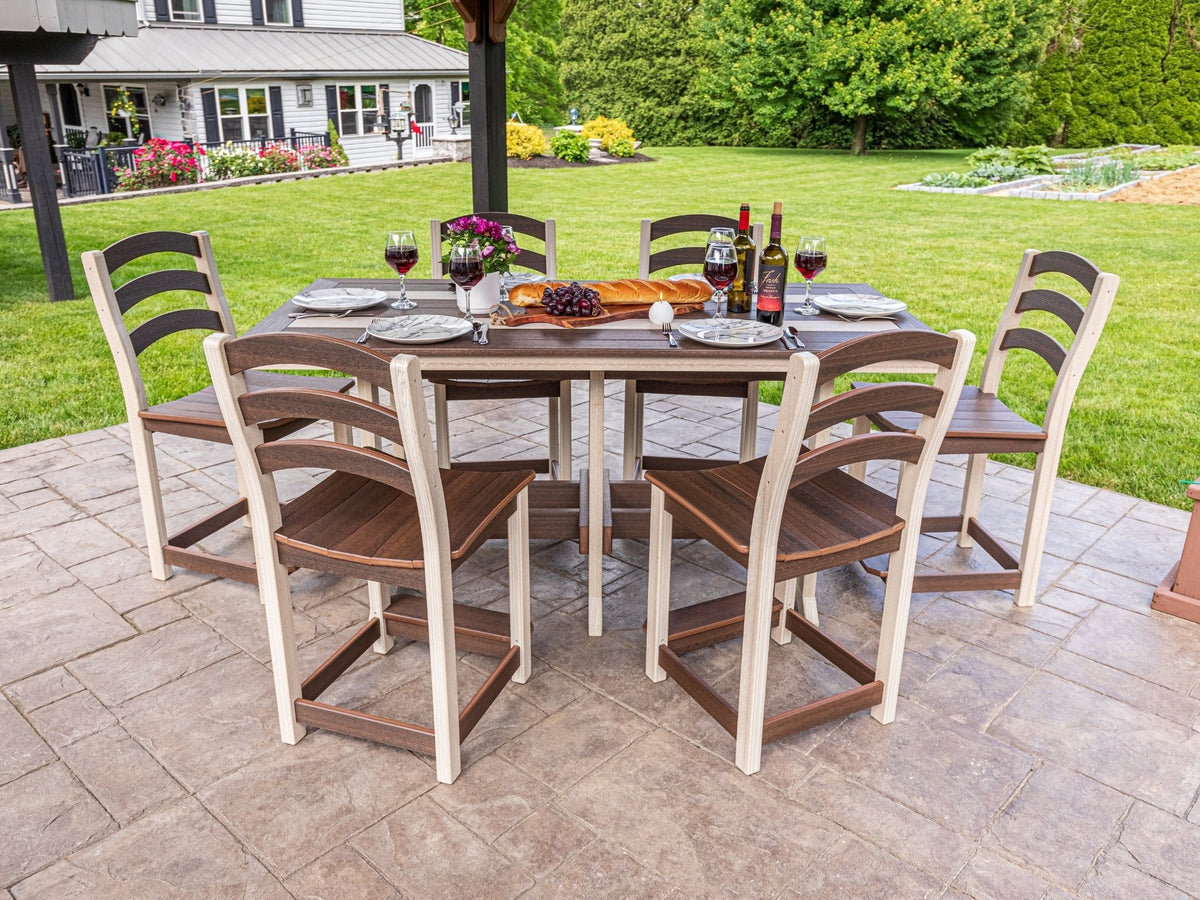
Choose armless outdoor dining chairs when table space is tight, people need easy side entry, or you want the chairs to tuck in with fewer clearance concerns. Choose chairs with arms when the table has enough room for the complete frame and the regular users prefer a place to rest their forearms.
The deciding measurements are not the ones most shoppers check first. You need the chair's full width, arm height, table-apron clearance, and occupied pull-out space. Seat width alone cannot tell you whether an armchair fits under the table or whether six complete chair frames fit around it.
Arms vs. armless at a glance
| Decision | Chairs with arms | Armless chairs |
|---|---|---|
| Best starting point | Roomy table and users who prefer arm support | Tight table spacing and flexible entry |
| Table check | Arms must clear the underside and apron | No arm-to-apron conflict |
| Space per chair | Complete frame may be wider | Usually a simpler fit along a crowded edge |
| Getting seated | Most people enter from the front | Side entry and small position changes are easier |
| Visual effect | Heavier, more defined seat positions | Lighter, more open rhythm around the table |
| Mixed arrangement | Often used at table ends | Often used along the long sides |
| Beaver Dam option | Native option on the Seabreak Signature Chair | Native option on the same chair and selected sets |
Neither style is automatically more comfortable. Arms, seat shape, back angle, height, and the user's body all affect the result. The better chair is the one that works for the people who will sit there and the table they already own.
Start with the table apron
A chair can have the right seat height and still refuse to tuck under the table. The usual conflict is not the tabletop. It is the apron, crossbar, or other structure below it.
Measure from the patio surface to the lowest obstruction beneath the table. Then compare that number with the chair's arm height at the point that would pass under the edge. Do not measure only to the top of the table.
If the arms hit the apron, the chair will stop farther from the table. That can create three problems:
- the person sits farther from the plate;
- the chair occupies more patio space when not in use; and
- the pull-out zone starts farther into the walkway.
Current outdoor-chair guides treat arm height and under-table clearance as a primary fit check, but the exact numbers vary by furniture.[5] Use the specifications for the exact chair and table rather than a universal rule.
Armless chairs remove this particular conflict. They still need the correct seat-to-table relationship, which is covered in our dining, counter, and bar-height guide.[4]
Seat width is not the chair's full width
The current Seabreak Signature Chair is offered with or without arms in dining, counter, and bar heights. Its product page lists 19-inch seating-area width and says those dimensions do not represent the chair's overall footprint.[1]
That distinction matters. A 19-inch seat does not mean the complete chair uses 19 inches along the table edge. Arms, rear posts, legs, and the angle of the frame can add width outside the seating area.
For every chair position, record two separate numbers:
- Usable seat width: the space available to the person.
- Overall frame width: the space the entire chair needs beside neighboring chairs and table legs.
If the overall width is not published, ask for it before ordering. Do not estimate it from a front-facing image. Perspective, camera angle, and empty space around the product can make two chairs look more alike than they are.
Count complete chair frames, not place settings
A table listing may say it seats six, but the chair configuration still matters. The current 36-by-72-inch Seabreak table-and-chairs set has a native choice between chairs with arms and chairs without arms.[2]
That option should prompt a physical layout check, especially if the table sits near posts, railings, or a narrow walking route.
For one long side of the table, use this planning test:
Available chair edge = clear table edge between the legs or supports
Then compare the combined overall widths of the chairs that will sit on that edge. Leave enough separation for hands, elbows, and the frames to move without scraping. There is no responsible universal gap because chair shapes and user needs differ.
Table corners deserve their own check. On a rectangular table, a side chair and an end chair can compete for the same corner space. Wider arm frames may make that conflict show up sooner. Our round-versus-rectangular table guide covers how chair positions change with table shape.
Think about how people get in and out
Armchairs usually ask the person to approach and leave more directly from the front. Armless chairs allow more sideways movement before the chair is fully pulled out.
That difference can matter when:
- a chair backs toward a wall or railing;
- several people need to leave the table during a meal;
- children frequently move in and out;
- the patio has one narrow approach route; or
- the chair is heavy enough that small sideways adjustments are preferable to a full pull-out.
Do not treat armless as universally easier or arms as universally more supportive. Have the regular users sit in both styles if possible. Pay attention to hip room, shoulder position, the way each person pushes up from the seat, and whether the arms interfere with a preferred sitting position.
The decision may differ from one household member to another. That is a good reason to test, not a reason to average everyone's needs into one imaginary "standard" user.
Include the complete occupied dining zone
Chair-to-chair spacing is only half of the layout. People also need room to pull out the chair, sit, stand, and walk behind it.
Our outdoor dining-table space guide uses 36 inches from the table edge as a practical starting point for chair use. It recommends 44 to 48 inches where the same side must also function as a walkway.[3]
Those measurements start at the table edge. If an armchair cannot tuck under the apron, its resting position may already be farther out. Tape the chair's actual resting position and pull-out path rather than adding clearance to an idealized tucked-in position.
Check the layout with every chair occupied. An empty dining set often looks spacious because the chairs are pushed in and nobody is using the path behind them.
When a mixed arrangement works
A common arrangement uses armchairs at the ends of a rectangular table and armless chairs along the long sides.[5] The ends may have more lateral space, while the armless side chairs preserve room along the table edge.
A mixed arrangement is worth considering when:
- two regular users strongly prefer arms;
- side-chair spacing is tight but the table ends are open;
- you want defined end positions without making every chair wider; or
- chairs are being purchased separately in matching height and style.
Do not assume a preconfigured dining set can be ordered in a mixed layout. The current 36-by-72-inch Seabreak set presents one Chair Arms option for the set: either Without Arms or With Arms.[2] If you want a mixed configuration, confirm the exact cart lines, quantities, heights, colors, and pricing before ordering.
Use this five-measurement test
A tape test takes less time than returning a dining set.
1. Measure under the table
Record the height from the patio surface to the lowest apron, brace, or crossbar. Check all sides because the structure may not be identical at the ends and along the length.
2. Measure the complete chair
Record overall width, depth, arm height if present, and the position of the legs. Keep seating-area measurements separate.
3. Mark every chair position
Use painter's tape to mark the complete chair frame at the table. Include side and end positions, then look for corner conflicts and table-leg interference.
4. Add the pull-out path
Move each taped chair position outward as someone would when sitting down. Keep the route to the house, grill, steps, and yard open.
5. Test with the regular users
Use a chair of similar height and width if the exact model is not available. Have each person sit, eat, turn, stand, and walk behind another occupied seat. A layout that passes on paper can still feel awkward in use.
How to choose for your patio
Choose chairs with arms when:
- the table apron clears the arms;
- the complete frames fit without crowding neighboring seats;
- the patio has room for the resting and pull-out positions;
- the regular users prefer arm support; and
- the wider visual presence suits the table.
Choose armless chairs when:
- table-edge space is limited;
- side entry is useful;
- arms would hit the apron or table structure;
- chairs move between dining and overflow seating; or
- you want a more open look around the table.
Choose a mix only after confirming that the exact chairs share the correct height, seat relationship, finish, and ordering path.
Once the configuration is settled, use physical samples to choose the finish. Our outdoor furniture color-testing guide explains how to compare colors in the actual patio light.
Questions shoppers ask
Are dining chairs with arms always wider?
The complete frame often extends beyond the seating area, but the amount depends on the chair. Compare published overall widths for the exact armed and armless versions. If only seat dimensions are listed, request the full frame measurements.
Will armchairs fit under my outdoor table?
They fit only if the arm height clears the lowest apron, brace, or tabletop structure. Measure both pieces on the actual patio surface. Uneven pavers or a sloped slab can change the relationship slightly.
Are armless chairs better for a small patio?
They are a sensible starting point because they remove arm-to-table conflicts and can make side entry easier. They still require full pull-out and walkway room, so complete the dining-zone test before buying.
Can I use armchairs only at the ends of the table?
Yes, if the end positions have enough width, apron clearance, and pull-out space. Confirm that the arms and side-chair frames do not collide near the corners.
Should I choose the chair style before the table?
If you already know that certain users need a particular chair, choose the chair and table together. Otherwise, start with the table size and shape that fit the patio, then verify which chair configuration fits its apron, legs, and available edge space.
Sources
[1] Signature Chair | Seabreak Collection
[2] 36 x 72 Rectangular Table & Chairs Set | Seabreak Collection
[3] How Much Space Do You Need for an Outdoor Dining Table?


